
Sleep and Relaxation Resources
Seven areas people commonly ask about, expanded below. These are general educational suggestions only — not individualised advice, and not a treatment plan. No technique here guarantees sleep, and none of them replaces professional assessment.
How to use this page
Read These as Ideas, Not Instructions
Sleep advice has a tendency to be presented as a checklist that everyone should follow. That framing causes problems of its own.
For one thing, no general suggestion can account for your circumstances — your working hours, your household, your health, your responsibilities. For another, turning suggestions into rules creates something else to succeed or fail at, and sleep is already carrying more performance pressure than it can usefully hold.
So the sections below are written as descriptions of what tends to be involved and why, rather than as steps to complete. Take what looks relevant, adapt it to what is actually possible in your life, and leave the rest.
And if your sleep difficulty has been persistent, please treat none of this as a substitute for speaking with an appropriately qualified healthcare professional.

General information only
Everything on this page is general educational content. It is not individualised medical advice, it has not been tailored to your circumstances, and it cannot be. No technique described here guarantees sleep or any particular outcome.
If sleep difficulties are persistent, severe or worsening, please seek evaluation from an appropriately qualified healthcare professional.
The resources
Seven Areas Worth Understanding
Expand any section to read it in full.
A wind-down routine is not a ritual with special properties. It is simply a period of reduced demand placed between the active part of the day and the attempt to sleep. Its usefulness comes from two things: it lowers stimulation, and after enough repetitions it becomes a recognisable signal that the day is ending.
Duration matters more than content. Twenty minutes of something undemanding is more useful than five minutes of something ideal. What you do in that period is far less important than the fact that the period exists at all.
Consistency builds the signal. A sequence repeated in roughly the same order at roughly the same time becomes a cue over weeks. A different approach each night never becomes one. This is a slow effect; it does not appear on day three.
Make it genuinely possible. A routine designed for an idealised evening will be abandoned the first time real life intervenes, and the abandonment tends to feel like a personal failure. A shorter routine you can actually keep is worth considerably more than a longer one you cannot.
If you work shifts, the anchor is the sequence rather than the hour. The same short series of steps before sleep, whenever sleep happens to be, is the version of consistency available to you.
A wind-down routine may support relaxation. It does not guarantee sleep, and it does not address physical causes of disturbed sleep.
Stimulation in the evening comes in several forms, and they are worth separating because they work differently.
Light. Light is a primary timing signal for the body clock. Bright light late in the evening — including from screens held close to the face — sits in tension with winding down. Dimming household lighting in the last part of the evening is a low-effort adjustment that costs nothing.
Cognitive engagement. This is frequently underestimated. Work email, news, discussion threads and absorbing content all engage the mind, and an engaged mind does not switch off on request. The issue is less the screen than what is on it: a gripping novel is more activating than a dull television programme.
Emotional activation. Difficult conversations, distressing news and anything that generates strong feeling raise arousal that then has to come down again. Where there is any choice about timing, earlier is easier than later.
Caffeine. Caffeine remains active in the body for a considerable period, and sensitivity varies widely between individuals. Some people are unaffected by an evening coffee; others are affected by one taken in the early afternoon. Personal observation is more informative than a general rule.
Alcohol. Alcohol is commonly used as a sleep aid because it can shorten the time to fall asleep. It is, however, associated with more fragmented sleep in the second half of the night. People who wake at three or four and cannot return to sleep sometimes find this pattern relevant.
If you are wondering whether a prescribed medication is affecting your sleep, please raise it with the healthcare professional who prescribed it rather than adjusting it yourself.
The physical properties of a room — darkness, quiet, temperature, comfort — are worth attending to, but they are rarely the main factor in a persistent difficulty. The more interesting question is usually what the room has come to mean.
What the space signals. A bedroom that is also an office, a dining area and an entertainment space is signalling several different activities at once. Where circumstances allow any separation — even closing a laptop and putting it out of sight — it reduces the ambiguity.
Darkness and light. Light exposure during the night can affect sleep quality. Blackout curtains, an eye mask or simply covering standby lights are all inexpensive adjustments.
Sound. Sudden noises are more disruptive than constant ones. Where a quiet environment is not achievable, some people find steady background sound more workable than intermittent silence.
Temperature. Core body temperature falls as part of the process of falling asleep. A room that is too warm works against that. Cooler is generally easier than warmer, within comfort.
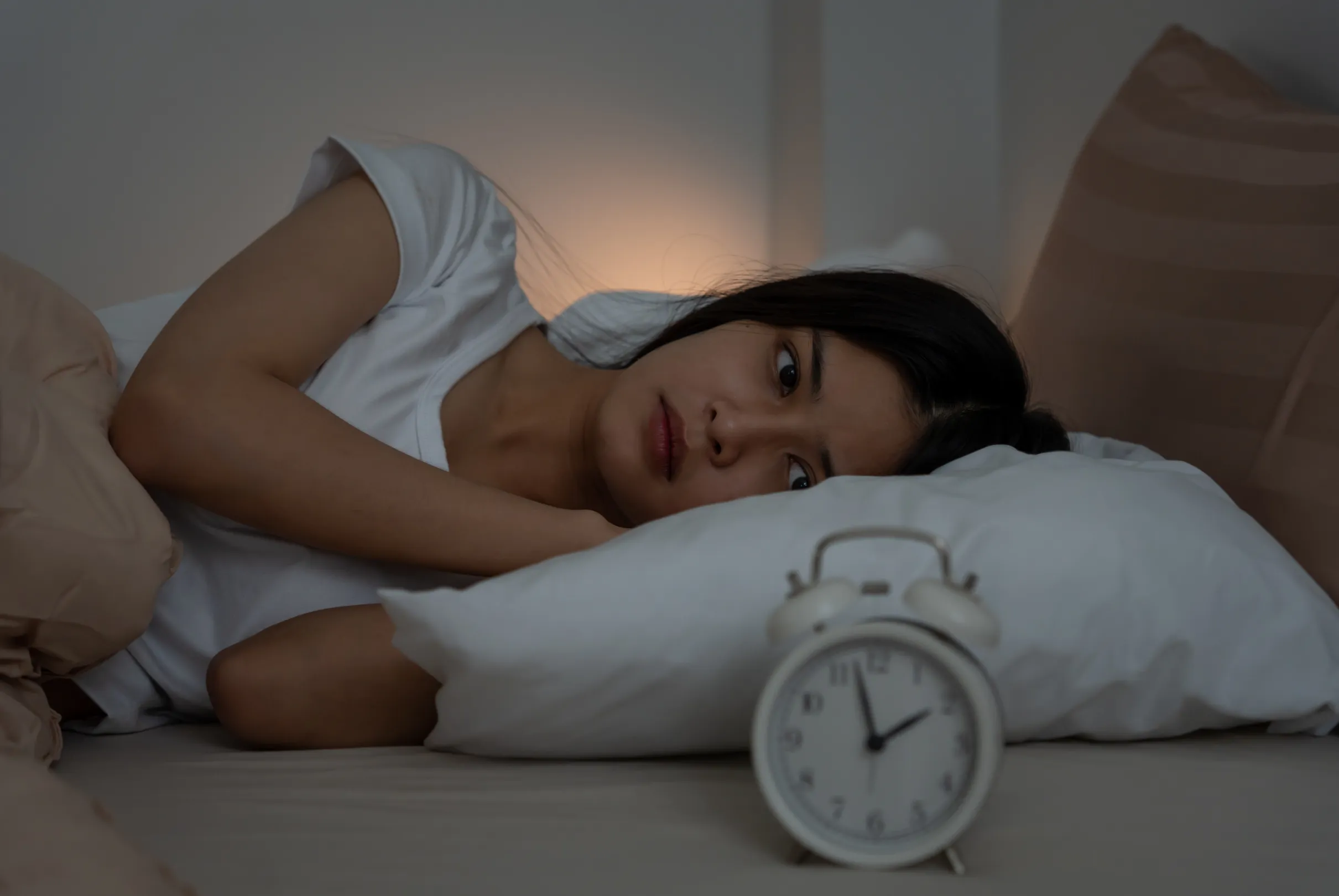
The clock. Of everything in a bedroom, a visible clock is the item most worth reconsidering. Being able to see the time supplies information at every waking, and that information invites calculation. Turning the clock away costs nothing and removes a reliable trigger.
Environmental adjustments may support better conditions for rest. They do not address medical causes of sleep disturbance.
Writing things down before bed is one of the more commonly suggested approaches for a mind that will not stop. The reasoning is straightforward: an unrecorded task has to be held in mind, and holding things in mind is an activity. Putting them somewhere external removes the need to keep rehearsing them.
Two different uses. A practical list — the things that need doing tomorrow — addresses one kind of mental activity. Writing about what is on your mind more generally addresses another. They are different exercises and it is worth knowing which one you are doing.
Timing matters. Doing this immediately before lying down can be counterproductive, because it brings the material into focus at the last moment. Earlier in the evening — with a buffer afterwards — tends to work better.
Keep it brief and unpolished. This is not a writing project. A few lines is generally sufficient. The point is that the material has been placed outside your head, not that it has been thoroughly explored.
It does not suit everyone. Some people find that writing about a worry gives it more prominence rather than less. If you try it for a couple of weeks and it appears to be making things more active rather than less, that is useful information and a reason to stop.
If writing consistently brings up distressing material, this is worth raising with an appropriately qualified professional rather than working through alone.
Relaxation practices work by lowering physical arousal and by giving attention a specific place to be. Both matter. A mind with nowhere to rest tends to go looking for something to do.
Slow breathing. Lengthening the out-breath relative to the in-breath is the common thread across most breathing approaches. It does not need to be precise or counted to a particular rhythm; comfortable and unforced is more important than exact. Straining to achieve a specific count is self-defeating.
Progressive muscle relaxation. Working through the body in sequence, releasing tension group by group, gives attention a structured task and often reveals held tension the person had not noticed. It suits people who find visual approaches unhelpful.
Attention to sensation. Simply directing attention to physical sensation — contact with the mattress, the weight of the body, the temperature of the air — is a low-effort option that requires no technique to learn.
The critical caveat. These practices are worth doing for their own sake, as relaxation. The moment they are performed in order to fall asleep, they become a task with a success condition — and checking whether they are working is exactly the kind of monitoring that keeps a person awake. This is the most common way relaxation practice backfires.
Effects tend to be gradual. Ten minutes of breathing will not undo a sustained period of high activation. If there is benefit, it is usually cumulative over weeks rather than dramatic on the first attempt.
Relaxation practices may support a calmer state. They do not guarantee sleep and are not a treatment for any condition.
Of everything on this page, this section is the one most likely to be relevant to someone who has already tried the other six.
Averages are not requirements. Widely quoted figures about how many hours adults need are population averages. Individual sleep needs vary. Treating an average as a personal target creates a standard that many people will not consistently meet — and then a nightly opportunity to fail it.
Waking during the night is normal. Brief awakenings are a standard feature of sleep architecture. Most go unremembered. Discovering that you woke three times is not in itself evidence of a problem; whether returning to sleep was difficult is the more meaningful question.
Perception of sleep is unreliable. People are generally poor at estimating how long they were awake, and time spent awake at night tends to feel considerably longer than it was. A night that felt sleepless was often not entirely so.
Tracking cuts both ways. Some people find sleep-tracking data useful. Others find that a number contradicting how they feel gives them something new to worry about. If tracking has increased your concern rather than informed it, stopping is a legitimate option.
One poor night is not a pattern. Occasional bad nights are part of ordinary human sleep. Responding to one as though it signals the return of a problem can be the thing that reinstates the problem.
The most important item on this page is knowing when self-directed approaches are the wrong tool. Several causes of disturbed sleep cannot be identified without assessment and do not respond to relaxation techniques.
Please speak with an appropriately qualified healthcare professional if:
- Sleep difficulty has persisted for several weeks or longer.
- Daytime sleepiness is affecting your safety, particularly when driving or operating machinery.
- You have been told that you snore heavily, gasp, choke or stop breathing during sleep.
- You experience unusual movements, sensations or behaviours during the night.
- Sleep is disturbed by pain, breathlessness, reflux or other physical symptoms.
- You feel persistently unrefreshed despite apparently adequate sleep duration.
- Your mood is persistently low, or anxiety is significantly affecting daily life.
- You suspect a medication may be contributing.
- You are considering changing or stopping any prescribed medication.
On medication specifically: never stop, reduce or alter prescribed medication on the basis of anything read on a website, including this one. Any change should be discussed with the healthcare professional who prescribed it.
In an emergency, or if you are having thoughts of harming yourself, contact your local emergency services or seek urgent medical help immediately.
A closing thought
Start With One Thing, Not Seven
The most common mistake with a page like this is trying to implement all of it at once.
Adopting seven changes simultaneously creates a demanding new evening regime, produces seven new opportunities to fall short, and makes it impossible to tell which change, if any, made a difference. It also turns sleep into an even bigger project than it already was — which is the opposite of the direction that helps.
Pick the one that looks most obviously relevant to your situation. Give it a few weeks without evaluating it nightly. Then consider whether to add anything else.

Important
When General Suggestions Are Not the Right Tool
There is a point at which continuing to try things on your own stops being sensible.
If you have made reasonable adjustments over a period of weeks and the difficulty has not shifted, that is not a sign that you need to try harder or find a better technique. It is usually a sign that something is involved which general suggestions do not reach.
Physical causes, medication effects, mood-related factors and timing disorders all fall into that category. None of them responds to a wind-down routine, and none can be identified from an article.
Involving an appropriately qualified healthcare professional at that point is not an escalation or an admission of anything. It is simply the next reasonable step.
Get in touch
Prefer to Talk It Through?
General suggestions can only go so far. If you would like to discuss your own situation and ask whether hypnotherapy is worth exploring, get in touch with Vibha Jain.