Sleep Challenges
Seven experiences people commonly describe, taken one at a time. Each section covers what the experience is like, some of the behavioural and emotional context around it, and when it makes sense to involve a professional. None of this diagnoses anything.
Racing Thoughts at Night
The body is ready. The mind has other plans — and it appears to have saved them all for this precise moment.
The content is usually mundane rather than dramatic: an email that should have been sent, a slightly awkward exchange from Tuesday, a list for tomorrow, a decision that has been deferred for a fortnight. Occasionally something larger. What makes it difficult is not the importance of the material but the fact that it arrives in sequence, without pause, and each item generates the next.
There is a structural reason this happens at bedtime specifically. For most people it is the first period of the day with no external input — no screen, no conversation, no task. The mind has been busy, but it has been busy responding. Given quiet, it starts processing — and processing feels a great deal like being kept awake.
The context around it
Attempts to stop thinking generally make it worse, because monitoring whether you have stopped is itself a thought. Days with no reflective gap in them tend to push more material into the night. And once a person begins to expect racing thoughts, the expectation adds a layer of alertness of its own.
When to involve a professional
If the thoughts are persistently distressing rather than simply busy, if they involve significant anxiety or low mood, or if this has continued for a sustained period and is affecting daily functioning, this is worth raising with an appropriately qualified healthcare professional. Persistent nighttime rumination is sometimes connected with conditions that benefit from proper assessment.

Bedtime Anxiety
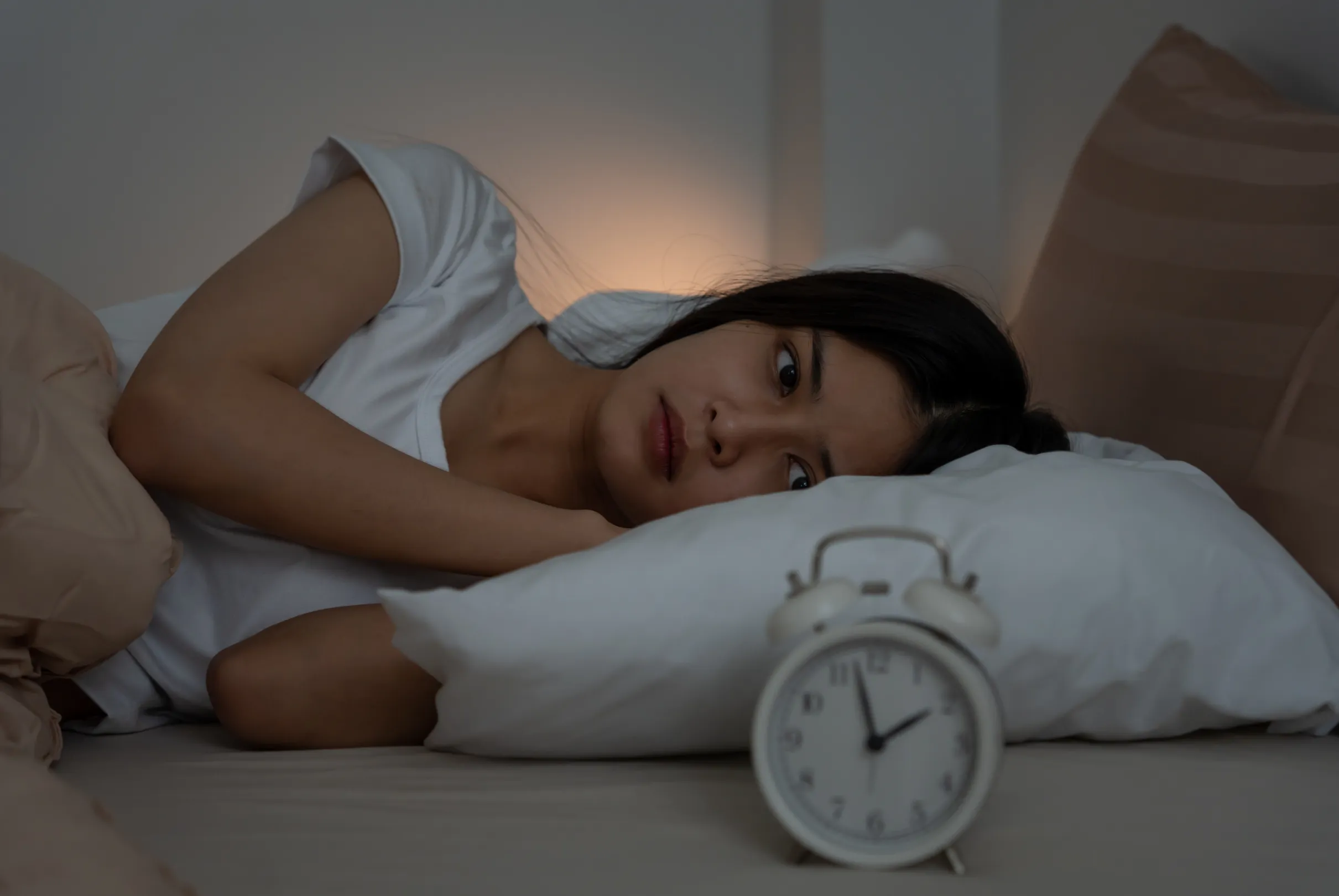
A particular kind of unease that attaches itself to the approach of night. It is not anxiety during the night so much as anxiety about it — and it can start in the early evening.
People describe watching the clock move toward bedtime with a sinking feeling, delaying going up, or finding reasons to stay downstairs a little longer. The bed itself can begin to feel like somewhere unpleasant is about to happen.
The context around it
This is usually learned rather than arbitrary. After enough difficult nights, the setting acquires an association — the same way any place repeatedly paired with an unpleasant experience does. The anxiety is a reasonable response to a genuine track record; the trouble is that it also raises arousal at exactly the moment arousal needs to fall, which makes the feared outcome more likely.
Avoidance behaviours tend to grow alongside it: putting bedtime off, falling asleep somewhere other than the bedroom, or staying up until exhaustion makes the question irrelevant.
When to involve a professional
If the anxiety extends beyond bedtime into other areas of life, if it involves physical symptoms such as a racing heart or breathlessness, or if it is severe enough to significantly affect your day, please speak with an appropriately qualified healthcare professional. Anxiety that is not confined to sleep may benefit from support directed at the anxiety itself.
Stress and Difficulty Winding Down
Winding down is a process with a duration. It is not a state that can be entered on arrival, and it does not compress well. A person who is fully engaged at eleven and expects to be asleep at eleven-fifteen is asking their system to do something it is not built to do.
Modern evenings frequently have no transition in them at all. Work continues on a phone until the moment of putting it down. A demanding day ends and bed begins, with nothing in between. The sequence is: full activation, then darkness, then an expectation of sleep.
What stress does specifically
Sustained stress keeps physiological activation elevated. Someone under significant ongoing pressure may be running at a higher baseline all day — and the descent to sleep from a high baseline simply takes longer. That is not a failure of technique; it is a longer distance to travel.
This is also why relaxation practices sometimes disappoint on first attempt. Ten minutes of breathing will not undo twelve hours of accumulated activation. Their value, if any, tends to be cumulative and gradual rather than immediate.
The context around it
Practical constraints are real here. Someone finishing a shift at ten cannot construct a leisurely two-hour evening. Parents of young children have limited control over the shape of their nights. Any suggestion about winding down that ignores this is not worth much — which is why the useful version of the conversation asks what is actually available in your life rather than prescribing an ideal.
When to involve a professional
If stress is at a level that is affecting your health, your relationships or your ability to function, that deserves attention in its own right rather than only as a sleep issue. An appropriately qualified healthcare professional can advise on what support is available.

Irregular Sleep Patterns
The body maintains an internal timing system that works on repetition. When bedtimes and waking times move substantially from day to day, that system has less to work with.
The most common version is not shift work — it is the ordinary gap between working days and days off. Rising at six on weekdays and eleven at weekends is a significant shift in timing, repeated every week. Monday morning can feel disproportionately difficult for reasons that have little to do with Monday.
Compensating for a poor night also tends to increase irregularity. Sleeping late after a broken night, or going to bed considerably earlier to catch up, both move the timing again — which can make the following night less predictable rather than more.
The context around it
Shift workers, people with caring responsibilities, those who travel frequently across time zones and anyone with unpredictable working hours face genuine structural constraints here. The realistic aim in those circumstances is rarely perfect regularity; it is usually finding whichever anchor points can be held steady.
When to involve a professional
If you work shifts and are finding sleep persistently difficult, or if your sleep timing seems markedly out of step with the day around you despite consistent effort, an appropriately qualified healthcare professional can advise. Some timing-related difficulties have specific approaches that a general relaxation method does not cover.
Repeated Nighttime Awakening
Brief awakenings are a normal feature of sleep and usually go unremembered. What turns them into a difficulty is what happens next.

What people describe
Coming fully awake rather than half-waking. Reaching for the clock. A rapid calculation of how long is left. Then a period of lying there — sometimes brief, sometimes an hour — before sleep returns, if it returns.
The context around it
Clock-checking is particularly worth noticing, because it converts a neutral moment into a piece of information the mind then works on. Frustration at being awake adds activation of its own. And once a person begins to expect a two-o’clock waking, the expectation itself can contribute to it.
This one especially warrants medical input
Repeated night waking is the pattern most commonly associated with physical causes — including breathing-related conditions, pain, reflux and medication effects. Please speak with an appropriately qualified healthcare professional, particularly if you have been told you snore heavily, gasp or stop breathing during sleep, or if you wake with physical symptoms.
Sleep Worry and Performance Pressure
There is a version of sleep difficulty that is largely produced by how hard someone is trying to solve it. It usually develops in people who are conscientious and well-informed — which is part of what makes it frustrating.
The sequence is recognisable. A person reads that adults need a particular number of hours. They start tracking whether they are getting them. A shortfall becomes a problem to be corrected. Corrective measures are introduced. Success or failure is assessed each morning. Sleep, which was previously automatic, is now a performance with a nightly score attached.
Nothing raises the stakes of a night quite like measuring it.
Where the pressure comes from
Widely circulated figures about how much sleep people should get are population averages, and individual needs vary. Treating an average as a personal requirement creates a target that many people will not consistently meet — and then a nightly opportunity to fail it.
Tracking devices can intensify this. A number in the morning that contradicts how you actually feel gives you something to worry about that you would not otherwise have had. Some people find this information useful; others find that it hands them a new reason to be anxious about sleep.
The context around it
The core mechanism here is straightforward: performance pressure raises arousal, and raised arousal impedes sleep. Which means the effort to sleep better is directly contributing to sleeping worse. Recognising this does not dissolve the pattern, but it does reframe what needs attention — which is usually the pressure rather than the sleep.
When to involve a professional
If concern about sleep has become preoccupying, or if you find yourself unable to stop monitoring despite recognising that it is unhelpful, this is worth discussing with an appropriately qualified healthcare professional.
Busy Lifestyle and Difficulty Switching Off
Some people are not anxious and not particularly stressed. They are simply running at a high level of engagement all day, and they have not built in any point at which that stops.
The pattern is common among people who find their work genuinely interesting, who carry several responsibilities at once, or whose day is structured so that one thing follows another without gaps. Nothing about it feels like a problem until the moment sleep is required.
A frequent feature is what might be called a permanent open loop — an ongoing sense that something is still pending. Because a phone makes work reachable at any hour, the working day does not have a definite end. It just becomes less active.
The daytime cost
Difficulty switching off does not only affect nights. It shows up as reduced concentration, shorter patience, and an odd sense of being tired without being able to rest — a state people often describe as being wired and exhausted simultaneously.
The context around it
The obstacle is frequently not knowledge but permission. Many people are perfectly aware that a buffer before bed would help; they have not given themselves grounds to take one. Where productivity is a strongly held value, a deliberately unproductive half hour can feel like something that has to be justified.
When to involve a professional
If you are running at a level that is affecting your physical health, or if the exhaustion has become persistent, please speak with an appropriately qualified healthcare professional. Sustained overload has consequences beyond sleep.

Recognising more than one of these?
That is typical rather than unusual. Sleep difficulties frequently involve several overlapping factors, which is one of the reasons a general formula tends not to work and why individual assessment matters.
These descriptions are educational, not diagnostic
Nothing on this page identifies what is causing your sleep difficulty, and recognising yourself in a description is not the same as having a condition. Sleep can be affected by physical health, medication, mood, environment, circumstance and habit — frequently in combination. Persistent or severe sleep problems should be evaluated by an appropriately qualified healthcare professional. Hypnotherapy is a complementary approach and is not a substitute for that evaluation.
Get in touch
Describe What Yours Looks Like
Your version will not match any of these exactly — nobody’s does. A conversation is the point at which the specifics can actually be discussed.